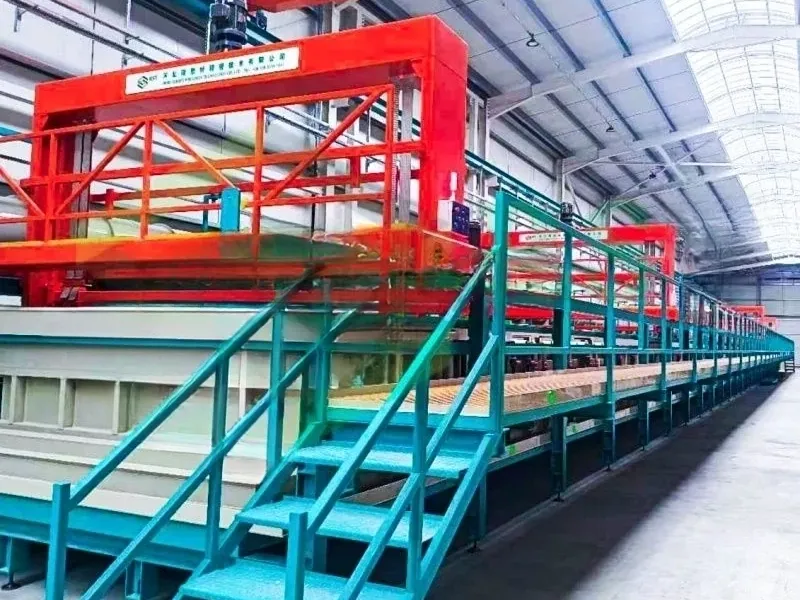
Acid Zinc Plating Production Line
| Brand Name | Hangzhou MetalWire Technology |
|---|---|
| Model Number | - |
| MOQ | 1 set |
| Price | Negotiable |
| Delivery Time | 45-60 days |
| Payment Terms | T/T, L/C |
Product Description
1. Overview
The acid zinc plating line is designed and manufactured for steel fasteners, stampings, brackets, electrical fittings, and other iron or steel components. Each line is engineered around the customer's workpiece dimensions, loading method, required coating thickness, hourly output, available workshop space, and local environmental requirements.
Rack, barrel, semi-automatic, and fully automatic configurations are available. The line can integrate pretreatment tanks, acid zinc plating tanks, rectifiers, filtration, temperature control, automatic transport, passivation, drying, exhaust collection, and wastewater treatment connections.
Send your workpiece drawings or photos, part dimensions, hourly capacity, and coating specification. The engineering team will prepare a preliminary process flow, equipment configuration, and workshop layout for your project.
2. Selection Guide
| Production Requirement | Recommended Selection |
|---|---|
| Small, durable parts processed in bulk | Barrel acid zinc plating line |
| Larger, fragile, or appearance-sensitive parts | Rack acid zinc plating line |
| Fasteners, washers, and small hardware | Barrel configuration |
| Brackets, stampings, and electrical fittings | Rack or barrel, depending on size |
| Simple or relatively open part geometry | Acid zinc process is normally suitable |
| Deep recesses, blind holes, or complex internal threads | Evaluate alkaline zinc for improved thickness distribution |
| Hardened or high-strength steel | Confirm hardness, tensile strength, and hydrogen-relief requirements before line design |
| Multiple products and frequent process changes | PLC recipe control and adjustable transport programs |
3. Key Advantages
- Current efficiency above 95% – fast deposition rate and high productivity
- Extremely low risk of hydrogen embrittlement – ideal for high-strength steel and critical load-bearing parts
- Mirror-bright coating – low internal stress and no additional polishing required
- Eco-friendly – simple bath composition and low wastewater treatment cost
4. Applications
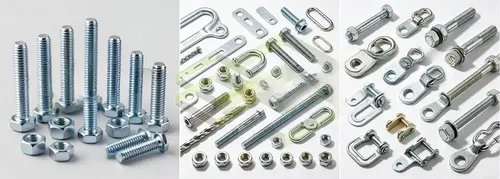
The line is suitable for high-volume barrel or rack plating where high corrosion resistance and a bright deposit are required:
| Industry | Typical Parts | Recommended Handling |
|---|---|---|
| Fastener manufacturing | Bolts, nuts, screws, washers | Barrel |
| Automotive components | Brackets, stampings, structural hardware | Rack or barrel |
| Electrical industry | Connectors, brackets, power fittings | Rack |
| Construction hardware | Anchors, fittings, and small steel hardware | Barrel or rack |
| Agricultural equipment | Small brackets, connectors, and hardware | Barrel or rack |
| General metalworking | Stampings, machined parts, and fabricated steel parts | Selected by part geometry |
| Commercial plating shops | Mixed customer parts | Flexible rack/barrel configuration |
5. System Integration
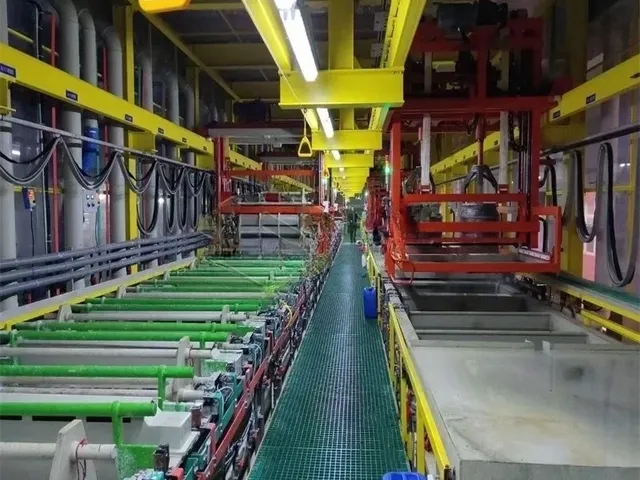
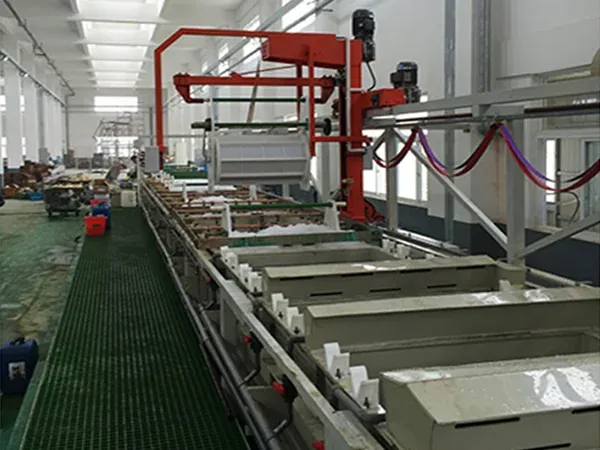
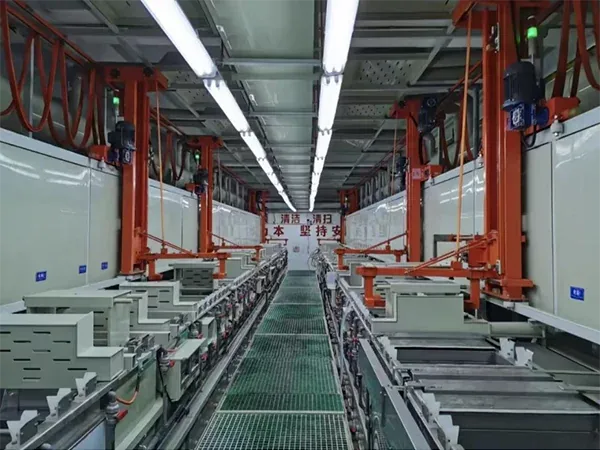
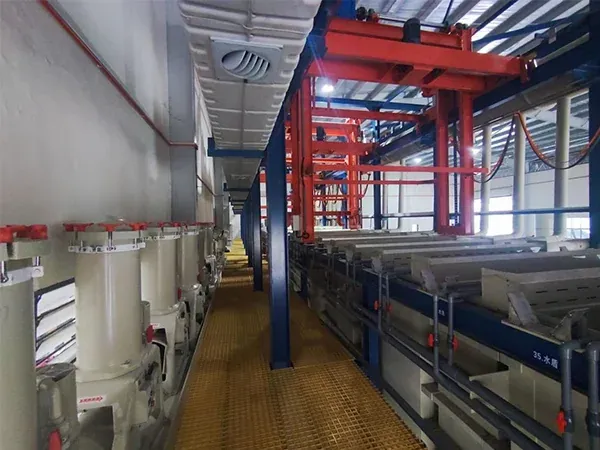
The acid zinc production line integrates the following units to form a fully automatic plating system:
- Tanks, frames, and operating platforms
- Crane transport system, racks, electrical control system, and rectifiers
- Level control system, filtration system, temperature control system, air agitation system, and cathode reciprocating mechanism
- Automatic chemical feeding system, exhaust gas treatment system, wastewater treatment system, and other units
6. Structural Features
- High-strength gantry crane: spans all process tanks with smooth operation and precise positioning
- High load capacity: suitable for heavy workpieces and long parts
- Dual-rail or single-rail guidance: stable lifting mechanism and easy maintenance
7. Process Flow
- Loading
- Chemical degreasing
- Hot water rinse
- Electrolytic degreasing
- Water rinse
- Acid pickling
- Water rinse
- Acid zinc plating
- Recovery / drag-out
- Water rinse
- Bright dipping (dilute nitric acid)
- Water rinse
- Trivalent or hexavalent chromium passivation
- Water rinse
- Hot water rinse
- Drying
- Unloading
8. Key Features
8.1 Flexible Process Layout
Process stages (degreasing, pickling, zinc plating, bright dipping, passivation, hot water rinsing, and drying) can be arranged according to workshop space and production capacity. The line supports reciprocating or skip-tank operation, and loading and unloading can be done at the same end or at opposite ends, facilitating changeover between product types.
8.2 Automated Control
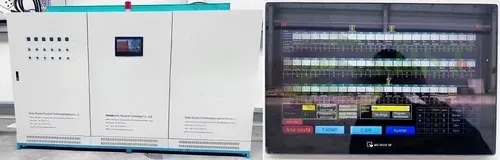
All process parameters, including crane travel path, dwell time, and cathode bar movement, are set through a touchscreen HMI. Different programs can be recalled with one touch, reducing manual intervention and operational difficulty.
8.3 Reliable Operation
Photoelectric proximity sensors and multi-directional limit switches ensure precise positioning and smooth crane movement between tanks, preventing collisions and operating errors. The dwell time for each stage is adjustable to accommodate different coating thickness requirements.
8.4 Compact Structure and High Efficiency
The frame-type design simplifies operation. Workpieces are automatically moved into and out of the plating tanks on racks; combined with reciprocating or skip-tank operation, this significantly increases output per unit area. The gantry crane structure is robust and suitable for continuous long-term operation.
8.5 Energy Saving and Versatility
Energy consumption is optimized to save electricity. Changing racks or adjusting cathode spacing allows the line to handle different workpiece sizes without modifying the main equipment, resulting in a short payback period.
8.6 Equipment Specifications
| No. | Item | Description |
|---|---|---|
| 1 | Main Materials | New polypropylene (NPP), PVC, stainless steel, carbon steel (frame) |
| 2 | Dimensions | Customized according to workshop layout and capacity requirements |
| 3 | Performance Features | Current efficiency above 95%; extremely low hydrogen embrittlement risk; mirror-bright coating with low internal stress; simple bath composition and low wastewater treatment cost; flexible process layout (reciprocating/skip operation); high-strength gantry crane with large load capacity |
| 4 | Typical Applications | Automotive parts (chassis and structural parts), fasteners (bolts, nuts, washers), hardware stampings, spring plates, electrical hardware, building hardware, agricultural machinery accessories |
| 5 | Advantages | Fully automatic control with touchscreen HMI; photoelectric sensors for precise positioning and reliable operation; high efficiency for heavy or long workpieces; compact, energy-saving design; integrated exhaust and wastewater treatment |
| 6 | Supporting Equipment | Rectifier power supply, filtration system, blower/air agitation system, exhaust gas treatment system (scrubber tower), wastewater treatment system, automatic dosing system, cathode moving device, temperature control system |
| 7 | Operation Modes | Fully automatic, semi-automatic (optional), manual (maintenance mode) |
| 8 | Warranty Period | One year from the date of shipment |
| 9 | Packaging Method | Eco-friendly wooden case wrapped with stretch film |
| 10 | Transportation Methods | By sea, by air, or by rail/truck |
| 11 | After-sales Service | Free replacement of damaged parts within the warranty period (excluding man-made damage); lifetime technical support with free online guidance and remote troubleshooting |
9. Rack or Barrel Acid Zinc Plating
9.1 Rack Acid Zinc Plating Line
Rack plating is normally selected for parts that:
- Are too large to process in a barrel
- Could become scratched, bent, or entangled during tumbling
- Require controlled electrical contact
- Have appearance-critical surfaces
- Need defined orientation during plating
- Require individual loading and unloading
Typical rack-plated parts include automotive brackets, sheet metal stampings, electrical fittings, structural hardware, and larger industrial components.
9.2 Barrel Acid Zinc Plating Line
Barrel plating is generally more efficient for large quantities of small, mechanically durable parts.
Typical barrel-plated products include:
- Bolts and screws
- Nuts and washers
- Rivets
- Small brackets
- Small stamped parts
- Construction hardware
- Agricultural hardware
- Other loose components suitable for tumbling
Barrel size, perforation, rotation speed, cathode design, and batch load are configured according to the smallest part dimensions, individual part weight, and required hourly output.
10. Coating Requirements to Confirm Before Design
To configure the correct acid zinc plating equipment, please specify:
| Requirement | Information Needed |
|---|---|
| Coating standard | ASTM B633, customer specification, or other applicable standard |
| Zinc thickness | Required minimum and target thickness |
| Appearance | Bright, clear, blue, yellow, black, or other specified finish |
| Passivation | Trivalent passivation type and color |
| Additional finish | Sealer, topcoat, or lubricant |
| Corrosion requirement | Required neutral salt-spray performance |
| Adhesion requirement | Test method or customer standard |
| Part material | Carbon steel, alloy steel, or other iron-based material |
| Material strength | Tensile strength or hardness for hydrogen-risk evaluation |
| Inspection | Thickness measurement, appearance inspection, and other required tests |
Common ASTM B633 zinc coating classes include 5, 8, 12, and 25 μm. The correct class and supplementary finish must be selected according to the actual service environment and purchase specification.
Salt-spray performance cannot be determined by zinc thickness alone. It also depends on passivation chemistry, sealing or topcoat, coating distribution, and process control.
11. Frequently Asked Questions
11.1 Is acid zinc plating suitable for all steel parts?
It is particularly effective for high-volume production where fast deposition and a bright finish are priorities. Parts with deep recesses, blind holes, or demanding thickness-distribution requirements may be better suited to an alkaline zinc process.
11.2 Should I choose rack or barrel plating?
Choose barrel plating for large quantities of small, durable parts. Choose rack plating for larger, fragile, appearance-sensitive, or individually positioned parts.
11.3 How is the capacity of the line calculated?
Capacity is calculated from the workpiece surface area, batch or rack load, target zinc thickness, plating time, transport cycle, and operating hours. A meaningful capacity cannot be determined from overall machine dimensions alone.
11.4 Can exhaust and wastewater treatment be included?
Yes. Exhaust hoods, ducting, scrubbers, segregated wastewater collection, and treatment equipment can be included in the project scope. Final design depends on the selected chemicals and local environmental requirements.